Dogs
Quo VadisDogs are presented as trained and exhibited animals, then deployed as executioners in the persecution of Christians. Their role changes from part of Nero’s imperial menagerie to the first beasts released against the condemned in the amphitheatre, where their hesitation, the crowd’s demands, and the emperor’s decisions shape the spectacle. The episode makes the animals instruments of a public violence that ultimately unsettles its audience.
Imperial Display and Procurement
At Nero’s procession, lions and tigers are led in steel chains by Arab and Indian handlers, their restraints entwined with garlands so that captivity takes on the appearance of decoration. This display establishes a larger courtly practice: dangerous animals are brought into view as possessions that can ornament the emperor’s power or serve his theatrical ambitions. Dogs later belong to the same machinery of spectacle, though they are made to perform a more direct role in the arena.
After the fire, Tigellinus orders a vast supply of animals for the planned executions. The authorities gather them from Italian towns and organize hunts across Africa; the imports include elephants and tigers from Asia, crocodiles and hippopotamuses from the Nile, and lions from the Atlas. The collection also includes Pyrenean bears and wolves, Hibernian hounds, and Molossian dogs from Epirus. This procurement reflects the scale of the punishment intended: Nero wants the games to exceed anything previously seen and to divert Rome’s attention from the catastrophe by turning Christian deaths into entertainment.
The First Attack in the Arena
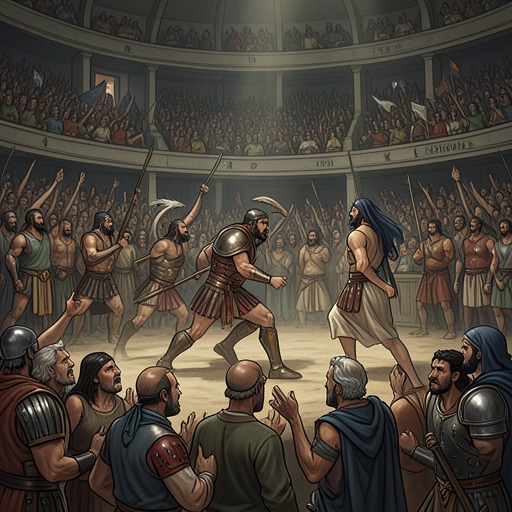
The dogs enter after the condemned have been driven into the arena in animal skins. The Christians kneel and sing; when the hymn ends, they remain still, repeating their profession of faith. The animals are described as famished: the Molossians are large, the Pyrenean dogs are pied, and the Hibernian hounds are wolf-like, with lean sides and bloodshot eyes. Yet they do not charge at once. Some run around the arena, while others linger by its walls, as if trying to escape toward the spectators. Their initial reluctance interrupts the audience’s expectation of instant violence.
The crowd responds not with pity for the condemned but with impatience, shouting encouragement in several languages. The dogs eventually attack, and more join in; the scene becomes a mass killing rather than the quick assault spectators had demanded. The Christians’ repeated words continue amid the tumult. Their composure contrasts with the audience’s agitation and makes the arena’s intended division between performers and viewers less secure: the condemned appear directed toward a belief beyond the spectacle, while the spectators are absorbed in its violence.
When the Dogs Refuse to Continue
When another group of victims is brought out in skins, the dogs are already exhausted. Most do not attack; some lie down, while others yawn or scratch themselves. Their refusal to continue changes the pace of the event. The audience, still demanding punishment, calls for the lions instead. Nero gives the signal to open the next entrance, and the dogs withdraw to the opposite side of the arena as the lions come in.
The contrast is narratively significant without making the dogs moral judges of the scene: their weariness, rather than a conscious choice, halts the attack. Yet the pause exposes how the spectacle depends on the continual replacement of one set of animals by another, and on an audience whose appetite for violence persists when the first means of satisfying it falters. The dogs are both agents of harm and creatures driven into an ordeal arranged by human authorities.
Spectacle, Authority, and Audience
The dogs’ appearance is part of an organized program of imperial entertainment, but its course is not wholly controlled from above. The crowd’s chants press Nero to release the lions earlier than planned. Because Nero values popular applause and seeks to channel anger after the fire toward Christians, he yields to the demand. Animal display, punishment, and political management converge: the emperor stages the condemned as a diversion, while the spectators’ response helps determine what happens next.
The episode also reverses the public’s expected emotional alignment. At first, the crowd interprets the Christians’ kneeling and singing as a reason to intensify the punishment. As the spectacle continues, the audience becomes disturbed and calls for it to stop. Dogs that had been collected and starved for the games thus become part of a scene whose violence exceeds its organizers’ promise of entertainment. Their presence reveals the arena’s dependence on coercion, both in the treatment of the animals and in the conversion of human suffering into public amusement.